Mindful Social Media Habits: Break the mindless scrolling


Do you feel like you’re in control of your social media usage? Or is your phone controlling you?
Do you regularly loose sense of any time and spend hours infront of your screen?
Would you love to get back to truly living and youre feeling like social media is intercepting this?
If you’re nodding along to any of this, you’re definitely not alone. The average person checks their phone 96 times per day – that’s once every 10 minutes during waking hours. When I learned that statistic, it actually made me feel less crazy about my own habits. Sometimes recognizing the problem is the hardest part, but it’s also the first step toward building healthier digital boundaries.
However, with a few curicial changes you can back the control, build mindful social media habits and take back control over your digital life.
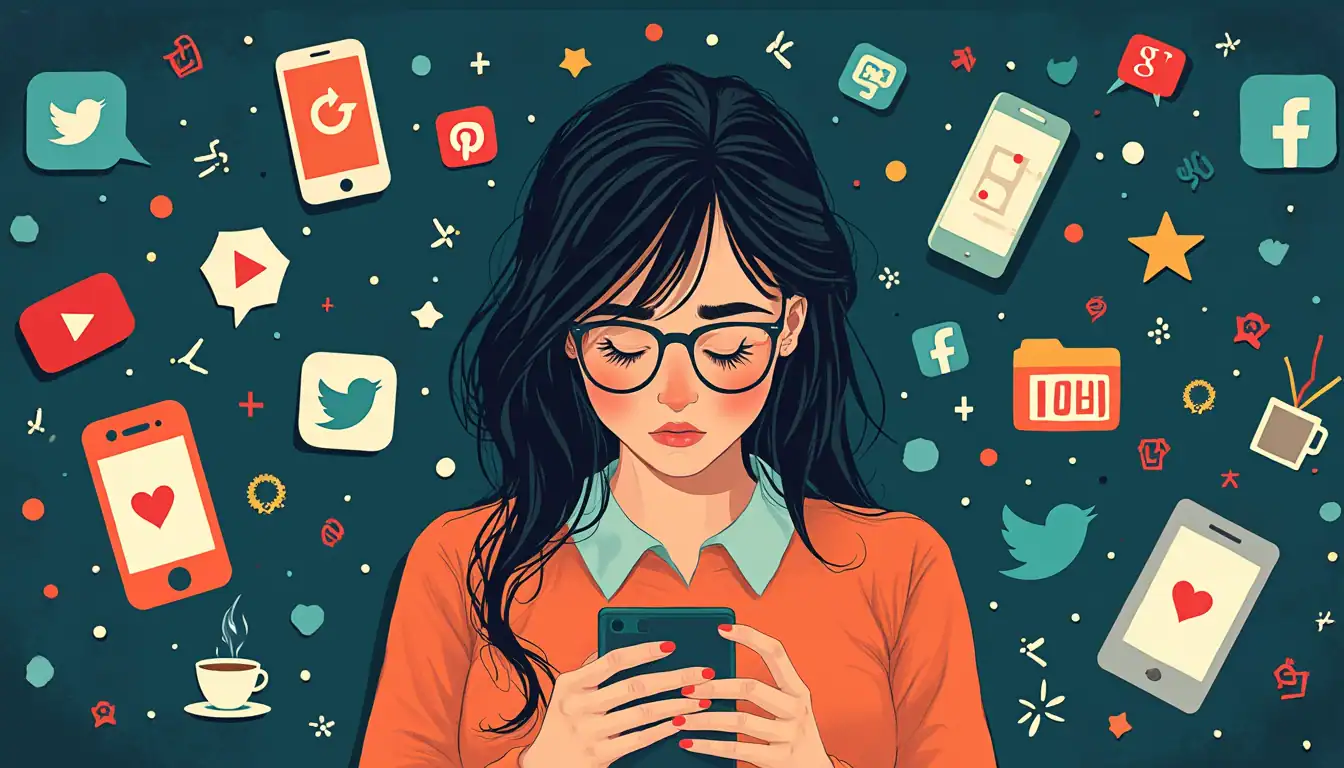
The Psychology Behind Mindless Scrolling
You know that feeling when you pick up your phone to check the time and suddenly realize you’ve been scrolling through Instagram for thirty minutes? Everyone has been there.
Here’s the thing about social media platforms – they’re literally designed by teams of neuroscientists and behavioral psychologists to keep us glued to our screens. These apps use something called variable ratio reinforcement, which is the same psychological principle that makes slot machines so addictive. Simply put the reward (a good/funny/interesting) comes at unpredictable intervals, which makes us crave it even more.
Every time you pull down to refresh your feed, you’re essentially pulling the lever on a digital slot machine. Sometimes you get rewarded with interesting content, sometimes you don’t. But that unpredictability is what keeps your brain coming back for more. The anticipation of potentially seeing something engaging triggers a release of dopamine, that reward chemical that makes you want to keep scrolling and to do it again and again and again.
I’ve noticed there are specific triggers that send me into these mindless scrolling sessions. Boredom is a huge one – like when I’m waiting in line or have a few minutes between tasks. It’s like whenever i got nothing to do right now and I see or feel my phone in the pocke or in front of me an intstant urge arises to use it and check out social media or dating apps etc. If I do not put my phone away out of my awareness this urge just grows until i “have” to check it.
Understanding these psychological mechanisms is the first step for change. As a little exercise you can simply observe how those urges arise in you. What triggers your phone use etc. Don’t try to change anything, fist just observe. You might get some really valuable insights.

Signs You Need More Mindful Social Media Habits
I’ll be honest with you – recognizing recognizing that you have a problem is always the first step of improvement. So here you need to be dead honest with yourself. I mean you probably are not reading this post if you think your social media usage is all good. Still, be honest to yourself: Does social media has a negative impact on your life?
If you actually do not know whether you have a problem, here a few indications that you actualy should be changing something.
Easiest to notice are the physical symptoms, if you use your phone so often that your neck starts hurting, your vision gets way worse, or your fingers start to hurt from the typing, then you are probably using it too much. For me it was just my overall posture that sucked cause of all the time in front of screens.
The emotional part is way worse, and it takes way longer to connect the dots. There are so many different symptoms that can arrise from social media overuse. Here a quick list:
- General FOMO (fear of missing out)
- Anxiety
- Overly stressed (for unknown reasons)
- Deminishing attention span
- Depressive syptoms (no motivation…)
- Low self worth (because of all the comparison)
The list of psychological symptoms that can arrise is endless, and often it can not be clearly related to social media. You can never be absolutely , but you you do not feel right and you do not know why chances are that you should spend less time on your phone. Ironicly in those times we tend to use it even more.
Then there is time: You can check your screen time easily, somewhere in the settings every phone has the option too look at how much time you are using it and which apps you are using the most. Just go and check, likely you spend 2-4 hours on social media every day. Thats basicaly I day per week of pure social media. Just look at the number and observe your reaction, maybe calculate the time per week, month, year and think what else you could be doing in that time.
If you don’t like what you see then you are perfectly right here.
The relationship red flags are very clear signs, if one of you is allways on the phone the other one will have noticed for sure and he/she surely does not like it. If you had problem in the relationship because of your social media truly ask yourself what is more important to you.
Sleep quality often becomes a joke. I do not even wanna think back to the days where I went to bed with my phone next to me. Laying awake for hours sometimes before I could finaly drift of. Blue light massively impacts your sleep, that is another way how social media can impact your life
Recognizing these patterns was the first step toward building a healthier relationship with social media – and trust me, it’s worth the effort to make that change.

Creating Boundaries and Intentional Usage Patterns
I’ll be honest with you – setting boundaries with social media can look hard, and it is. However, it is so worth it, just think about the quality of life you can have if you have control over your phone and not vice versa. Social media can be a awesome oportunity to connect and sometimes relax and have some fun. You just need to make a few crucial changes to your pattern of usage and soon you will feel so much more free.
I have intentionally oredered the following list per impact you get for the work done, there are a few simple changes that have such a great impact that the have the best “price-performance-ratio”
1. No phone in the bedroom
This is the single most impactful decision you can take to improve your digital well-being.
I do not think there is much to explain in here. I have a strict no phone in my bedroom policy and it improved my life so much. I have better sleep, get easier out of bed in the morning, more intimicy, the list goes on. All you need to do is to charge your phone somwhere else. Obviously it’s even better if you basicaly remove all screen devices from your bedroom. I only sleep or have sex in my bed that’s it.
And everyone who is already crying because of the clock or similar. Sorry but come on, just buy a simple alarm clock and there you go.
2. Timing restrictions
The next easy thing to do is to set times when you do not use your phone. Maybe no phone one hour befor and after sleep. Or my new favorite: No phone in the first 15 minutes after coming home, because that’s when I often collapse on my sofa and lose 2 hours of my day. You can go as crazy as you like, maybe you prefer only instagraming between 4 and 6 in the evening.
In addition to restricting the time windows you should also put a max time per day limit. And don’t put any of those pre installed that you can simply click away, they don’t really work, you know it, I know it, everyone who tried knows it. The exact time is your decision, mine is ultra low at 10 min for insta.
There any many applications that help you achieve this, just search for the one that works best for you. I love to put a password on the app and then either give it to someone else or safe it in a way that takes time to get.
3. Locations/Situation restrictions
Creating phone-free zones was harder than expected. Because the tendency to cheat yourself is big and it’s more difficult to help yourself with applications, like for time restrictions. But don’t worry just think about zones and situations that either you would enjoy more without the phone or you’d get a better outcome without your phone. Here a few ideas from my life.
- During meals
- When I am with someone, especially on dates
- Bus stations and short rides (I wanna be less part of the zombies around today)
- The place at uni where I work and learn for exams.
- Kitchen (I wanna focus on the meal I am cooking, no music, no podcast, and surely no Instagram post)
To put those places is really powerful, because there are certain situations where we just naturally grab our phone, remember the trigger exercise. We do so also because we did not put any rules, now when you say that you do not wanna use your phone/social media there you will only start to truly see those urges and stop them.
And just to make sure we are on the same page, you will cheat yourself on those situations 100% but it’s ok, simply try to do it most of the times and see how it is making you actually getting more out of your days.
Here’s what nobody tells you about digital boundaries – they need to be flexible. I tried being super rigid at first, like deleting my Instagram account etc, but that was just not sustainable. Set yourself boundaries that are enough flexible so you can follow them and build on success and not failure.

Mindful Engagement Techniques While Using Social Media
Then instead of the boundaries we can practice techniques that help us don’t drift of into the rabbit hole that fast.
1. Pause and breathe
The first technique is again simple and effective. The “pause-and-breathe” method. Before opening or also during scrolling through any social media app, I literally stop and take one deep breath, that’s it. I know it sounds too simple, but give yourself that moment of distance to find your center and then decide if that’s really what you wanna do right now. (Works wonderfully in other situations, too.)
2. Purpose before
The “purpose before ” approach was a game-changer, though it takes some getting used to. Before opening any social media app, I started asking myself three simple questions that I have from the wonderful book “How to Break Up with Your Phone” (for anyone who wants to take this one step further: What for? (purpose), why know?, what else (could you do to fulfill the need you have right now)?. Just get in the habit of asking yourself why you wanna use the phone, do you really want it? Isn’t there something better to do right now.
This is basically the first step of mastering a skill called mindfulness. Which is in general super helpful to navigate our with impulses overflowing life.
3. Thoughtful engagement
One trick that can truly help is changing your engagement style completely. Instead of just liking posts and mindless scrolling, Start leaving thoughtful comments or sharing content that resonated with you. This transformes social media from passive consumption into active participation. It’s another trick to become more mindful and decrease mindless scrolling.
These techniques aren’t perfect, and I still catch myself scrolling mindlessly sometimes. It’s only when you start to combine several techniques that you start to see real good improvements.
Maintaining Long-Term Digital Wellness
Here’s the thing about digital wellness – it’s not a “set it and forget it” kind of deal. I learned this the hard way after thinking I had my social media habits completely figured out, only to find myself three months later mindlessly scrolling through IG for 2 hours straight.
The key to maintaining long-term digital wellness is treating it like your physical health. You wouldn’t work out intensely for two weeks and then expect to stay fit forever, right? Same goes for your relationship with social media and technology. I now schedule what I call “digital wellness check-ins” every month, where I honestly sit down and reevaluate.
During these check-in I just ask myself whether I am doing what I said I would be doing. So you better write your rules down. Then what can I do to get back on track or stay on it. Any adjustments needed? This is the time, for the rest of the month you should stick to your own restrictions.
And there you have it, this is truly all you need to make build your first mindful social media habits. Try out what works for you and what does not. Don’t be too hard on yourself, and mostly enjoy the new time and energy you’ve got. Spend it on what really matters, like friends, family and truly wonderful experiences (which never happen on your phone)