How to create a vision board


Did you know that over 50% of the human cortex processes visual information? That’s why vision boards are such powerful tools for manifesting our dreams!
For many of us, visual imagination is a key process we use to learn and understand the world. Many people rely more on their visual system than their auditory(sounds) or kinesthetic (feelings) systems.
But for some reason, goals often only get written down, which is rather auditory than visual. However, a picture says more than 1000 words and a vision board can also be much more powerful than a few words written down.
Now a vision board may sound fancy but it is simply a visual representation of your goals and vision.
That’s why it is also quite easy to make one. Of course, there are many different ways to do it, and I try to show you some of the most effective ones in this short tutorial on how to create your vision board. The key here is to focus on a how we can get a high quality vision board in the least amount of time.
Now, even though the vision board is, in its essence, quite plain, its impact can be profound. Once you have clarified what you want in life and written down some goals or visions. You want to think about them all the time; they need to be upfront, in your brain and activated in your subconscious so progress comes naturally. A vision board helps you do exactly that.
Now you have a way to connect to your goals through a visual way, evoking strong emotions every time you look at it. This will be helping you to be motivated and stay on track.
Now, lets get started in less than one hour, you can have your own fully customized vision boards that connects you right to your purpose and dreams.
What Is a Vision Board and Why Does It Work?
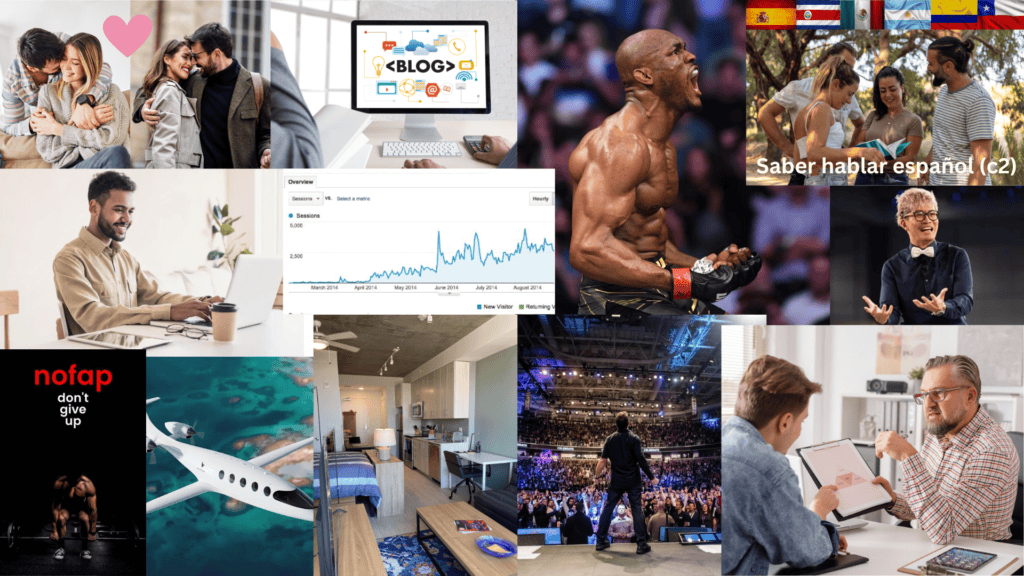
I have heard of vision boards ages ago, but for a long time I did never make my own. I always thought, that I have my goals written down I do not need more. But, I was just missing a simple boost in the availability of my goals that needed no time to complete.
Once you clarify your goals, you need to make them really salient. This is just a fancy way of saying that you need to think about your goals automatically all the time. You want to know what is important for your life right now, whatever you are doing, whatever state you are in.
You can achieve this in many different ways: talk about your goals, write them down, visualize them, create a vision board, and many more. The thing why a vision board is so powerful is that you can save it on your desktop or print it and put it on a wall, and then every time you look at it, you feel a connection to your goals. It only takes a few seconds because we are so fast in interpreting pictures.
Researchers found similar insights. Visual information is much more potent in activating the Reticular Activating System, short RAS. The RAS is the filter of your brain; it tells it which information it perceives is important and which is not. Your vision board will activate this RAS, and thus, it will actively search for more ways to achieve your goals.
You’ve got options when it comes to types of vision boards. The traditional physical vision board uses a bulletin board or poster board where you arrange magazine images and inspiring quotes. If you want to go the old-school way, there is absolutely nothing wrong with this.
But let’s be real. We live in a digital age, and making a digital vision board is much more effective and has many advantages. That’s why, in this post, we will focus on digital vision boards, but you can apply almost everything to the creation of a digital vision board.
What makes vision boards particularly effective is their ability to combine both logic and emotion. We often don’t even think about how reaching our goals would look like, creating your vision board makes you have to envision your dreams. You need to come up with ideas for how it will look. This is maybe a new way to look at some of your goals and will help you to clarify what it is that you really want.
Creating a vision board will be even more effective if you don’t even know what exactly are your goals right now. Then we will do a whole process of finding out what you want from life and then turning it into a visual representation you can look at every time you need to be remembered what truly matters to you.
Now, let’s get started creating your personal vision board.
Defining Your Vision
Obviously, it makes no sense to start working on your vision board if you do not yet have a clear vision of your future.
We will start there. Even if you already have a clear vision, this section can teach you a lot, and you may update parts of it or maybe you just need to clarify some things here and there.
First, we need to understand the difference between a vision and a goal. A vision is much more broad, it is not as specific as a goal. The vision is going to be your ultimate goal, the “end ” of the journey; a goal is just one step towards this vision.
Now, for the vision board, we want to focus (as the name suggests) on your vision. This means we are going to dream.
I love doing this. You are going to spend some time in your ideal life in the future. This is how I like to do this: First, I am dividing my life into categories. I will make personal and professional categories, because those two are often very different.
For my personal categories, I will look at my life and ask myself: “What are the most important areas of my personal life where I am committed to grow and expand?” This is about finding the areas in your life that have to grow no matter what. We all have parts of our life that are more important and parts that are less important. This dividing is crucial because it gives you the clarity of knowing where you need to focus most of your attention.
Everyone will have categories like personal fitness/health or friends/family, but some might be more unique to you. Aim for about 5 to 12 categories, depending on your lifestyle. It does not matter what you want to focus on as long as you are committed to putting in the work to improve those parts of your life.
Repeat the same process for your professional goals, and you have your categories of never-ending improvement. As always, they are not set in stone, especially the professional categories prone to change. It just has to fit your life today. Your professional categories might be more “random” than your personal ones. This really depends on your job. If you own a company, you might want to focus on customer satisfaction and delegating your work. If you are 18 and studying, you might want to get good grades and put work into a side project.
Now, obviously, you should start setting goals in all those categories to ensure your progress, but this is not what we are trying to accomplish here. A vision board is a bit like visualizing. We aim for the ultimate outcome to invoke the strongest emotions.
This is exactly what you have to do right now, but first. Get into a great state, maybe stretch a little, and jump around until you feel great. It is key that you feel strong and energized when you are doing this exercise. Then, ask yourself about every category you choose, how your life would look if you achieved that vision completely. Try to envision it, feel it, and hear it. We want to get a feel for it so, we know what kind of pictures we are going to look after in the creation of the vision board.
You might be thinking, “But what if I’m not sure about my long-term vision?” That’s totally normal! One exercise that’s been super helpful for me is what I call the “perfect day” visualization. Imagine your ideal day five years from now – what time do you wake up? What kind of work are you doing? Who are you spending time with? This helps create a more concrete visual representation of your future goals.
There is no right and wrong here, this is about connecting to your future. About having something to work towards. If you manage to hold a strong connections to those dreams, putting in the work will be so much easier.
Also, for all your categories, you should always focus on who you want to be in this category rather than what you are going to have. If you connect your vision to your identity, it will be a much stronger connection than anything else.
The inner work of aligning goals with your authentic self is probably the most challenging part. I’ve seen too many vision boards filled with images of luxury cars and massive houses simply because that’s what society tells us success looks like. Your vision board needs to reflect YOUR definition of success, not anyone else’s ideal life.
Because only what really matters to you will be able to create the drive and motivation you need to push through hard work and fulfill your goals.
I hope that by the end of this process, you have a clear sense of the areas of your life that you are committed to growing and improving, no matter what. And you also know what you ultimate outcome in all of those areas is. In other words you know what you are working towards. I hope that you were able to envision a future that got you emotional and excited to embark on your journey.
Essential Supplies for Creating Your Vision Board
Let me start by quickly covering the basics of physical vision boards before diving into the digital approach, which is my go-to method. For a traditional vision board, you really just need a poster board or bulletin board, some old magazines, glue sticks, and scissors. And quite some time. That’s it!
But here’s the thing – while physical vision boards are great, I’ve found that digital vision boards offer so much more flexibility for our modern lifestyle. And if you absolutely want a physical version of your board, you can order a printout and get the best of both words.
The process of creating your vision board is quite simple. You basically look for a minimum of one picture for every one of your categories of improvement that presents your ultimate vision. This can be the vision itself or something that is linked to the vision. Maybe you show a huge bank account that shows your financial freedom, maybe you show the car that you could buy if you had the money or it is a picture of someone doing exactly what you want to be doing in the future.
The key is to find pictures that evoke certain emotions in you. So if the car speaks more to you, take the car. Every person has his unique leverage points that will lead to stronger emotions. So, use the images that work for you. Still, i found that pictures linked to what you are going to do and who you are going to be will generyl be stronger. For me, those are about 90% of my board.
Remember, this is your poster, yours only, so whatever picture and vision you choose, it has to resonate with you. You only. I don’t want you to spend one second thinking about what others would say or even think about your poster.
Ok, then, let’s move on and discuss what you need for the digital board.
Again, it is simple: You need at least one source of images and a tool to arrange all the images together.
My personal favorite is still Canva. It combines everything you need. You can perfectly arrange all the pictures, and you can choose the size and resolution so that it fits your device of choice. They even have their own images you can use, which are quite good. There are AI features, and you can write on stuff and change colors, etc. It is basically an all-in-one package that combines everything you need to create your vision board.
However, you can use whatever you want; since this is yours, you can simply go to Google Images and search there. To arrange it, you can use Word, Google Docs, or whatever you like. I have seen people create their vision boards on the Notepad.
Of course you can also use any other image source like Unsplash or Pexels. I used different ones until i found the right picture for me.
In the End there is no right and wrong when it comes to the essentials your are going to use. All that you wanna do is end up with an arrangement of pictures that represent your visions. So use whatever is right for you. There are just more and less time-consuming approaches.
Step-by-Step Vision Board Creation Process
Before starting out with your vision board, take some time to connect it with your vision. This is not a process we want to hurry to; think about your ideal future. Feel it, enjoy it. Look that your mind is in a great place before we start.
I am now walking to the process as simple as possible so you can apply it to the way that you choose to create your vision board. If you have not. When would now be a good time to do it?
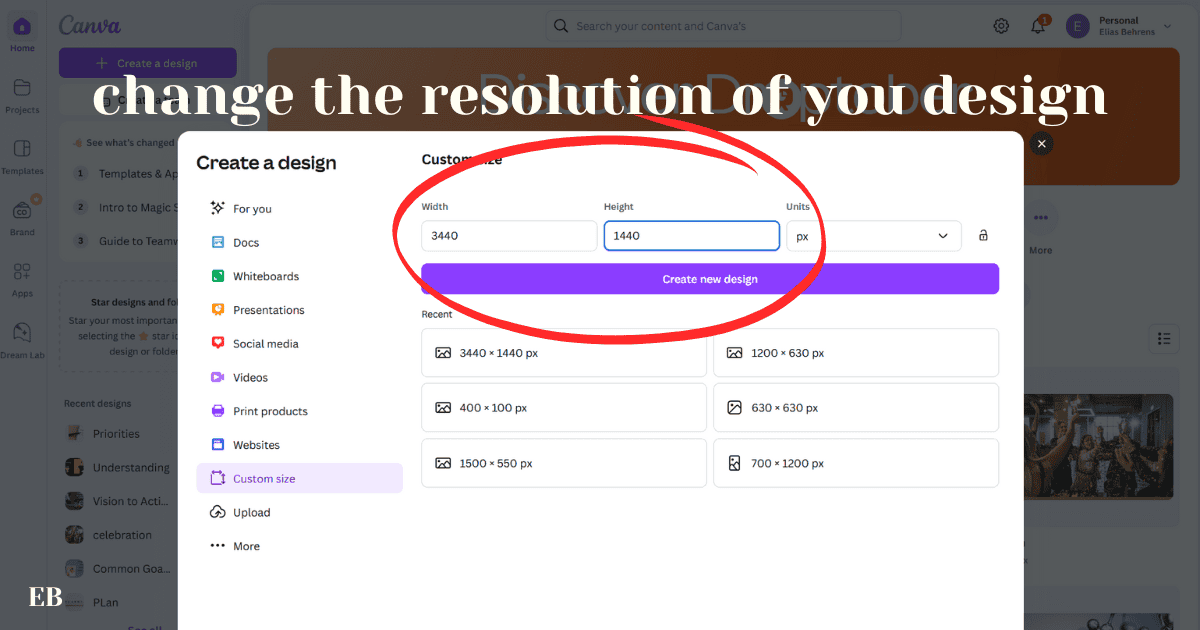
If you are creating a digital vision board and you plan to use it as your wallpaper, then it is best to see that the board you create matches the ratio of your screen. The ratio you will find in the settings on your laptop; if you use a monitor, google quickly. I use an ultrawide monitor that uses a ratio of 3340 *1440. On Canva, you can set the resolution when you create your design. (sadly, to change it afterward, you need the premium version)
Before we start searching for pictures, consider how many images will fit on your board and how much space you are committed to each dream. Maybe you need only one picture for finance, but for your relationship, you need two or three to tell the whole story of what you are wishing for. Also, think about the importance of every category of improvement when you are deciding on the space.
Don’t worry. This only needs to be a rough estimation. (it will most likely turn out completely different than you imagined)
Once you know approximately how many pictures will fit your board, we can start with the creation.
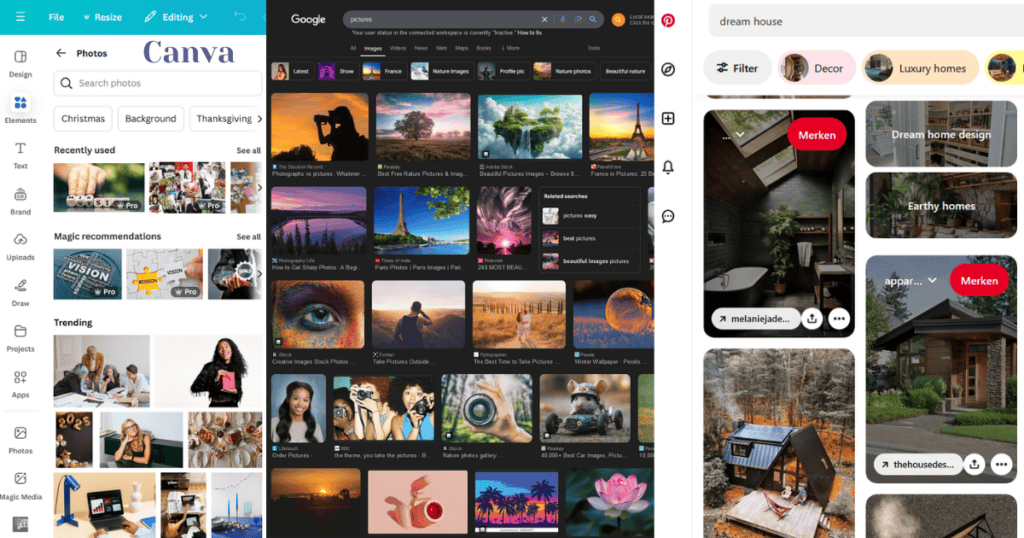
I suggest that you first look for some images and then start to arrange them. Now the process starts, start searching for your images on any site you know. I started with Canva and then moved on to Google Images and then to some other websites. Pinterest is great for inspiration.
Once you have found a picture that fits your vision and activates some emotions, you can download it. Look that you get the highest resolution you can get, it will look better in the end. Then copy it into your vision board and go on.
You can start arranging some of your pictures when you have them ready. There is no science to that. I would cluster images of the same vision together, but other than that, try around until it matches. Be experimenting around, change sizes, and maybe crop images.
Then, add more images and arrange further until your board is complete. Easy.
Before you start, keep one thing in mind: less is more. If you can define one part of your vision with only one picture, then do not use two. In the end, you also want your vision board to be easy to read. The fewer pictures you have on your board, the faster you will be able to look at them all and get that emotional boost you are looking for.
Now, what you can do is completely optional, and you should not overdo it. It is to add some inspiring words to the image. Or if an image may be ambiguous, add a word to clarify. Keep this simple because the pictures still carry the emotions.
Remember, the best life vision boards aren’t just beautiful – they’re functional tools that help manifest your dreams into reality. Take your time with the process, be intentional with your choices, and don’t be afraid to make adjustments as you grow. Your vision board should evolve just like you do, supporting your journey toward turning those dreams into your daily reality.
How to Use Your Vision Board Effectively
Making the board is just the beginning. The real magic happens in how you use it to stay focused on your goals every single day. Let me share some game-changing tips I’ve discovered about making vision boards actually work.
First up, let’s talk about placement. If you’re using a digital vision board like I do, make it unavoidable! Set it as your desktop background, your phone’s lock screen, or even as the homepage on your browser. The more you see it, the more you will be reminded what your dreams are and will move them more into focus.
There are many ways to use a vision board. In the end, you want it to help you think about your goals and visions all the time.
For example: spend the first five minutes of your morning really looking at your vision board. Not just a quick glance but really engaging with those visual representations of your dreams. Maybe even take it further and start visualizing them as well.
But it has not been that for you; I would at least once a week really take the time to look at your vision board and imagine how your life would be if all those pictures were reality for you.
I really think that vision boards are a great tool, but letting them stand alone they can not fulfill their full potential. It is because they are a vision board. And until you are not going to transform your vision into actionable steps. You are not going to have great results.
If you however combine the two and create goals for every vision you have. Then, the vision board will help you, giving you the emotional juice to push through hard work. It wont do the work for you but it can be a game change providing you with a little extra motivation and keeping the end goal clear in view.
Here’s a mistake I see people make all the time – they create their vision board and then expect things to happen magically. Reality check: vision boards work when they inspire action! I encourage keeping a simple progress tracker alongside your board. Every time you take a step toward one of your goals, note it down. These small wins really add up!
The whole point of having a vision board is to increase motivation and maintain clear direction. But here’s something interesting I’ve noticed – sometimes, what we think we want changes as we grow. That’s why I love digital boards; you can easily crop images, add new inspiring words, or completely redesign sections as your dreams evolve.
The bottom line? Your vision board is a tool, and like any tool, its effectiveness depends on how you use it. Stay consistent with your visualization practice, be willing to adapt as you grow, and always keep taking those small steps toward your dreams.
That’s how vision boards really work to transform your reality.
Conclusion:
Now, you should have all the knowledge you have to create a vision board.
Remember these three key things: place your vision board where you’ll see it daily, let the images truly represent YOUR dreams (not someone else’s), and combine your visual inspiration with actionable steps.
A vision board alone won’t manifest your dreams – but paired with consistent action, it’s a powerful tool for staying focused on your goals. Your brain processes visual information incredibly effectively, making your vision board a perfect daily reminder of where you’re headed.
If you need any vision board ideas, then go to Google or Pinterest and search for an inspiration board.
Ready to transform your dreams into reality? Start creating your vision board today. Your future self will thank you.